
Posted by Gojasu on Sep 6th 2026
Anime & Black Culture: The Cultural Exchange That Changed Both
Anime and Black American culture might seem like two completely different worlds.
One comes from Japan. The other developed from the unique history and experiences of African Americans in the United States.
But spend enough time looking at anime, hip-hop, fashion, music, and modern Black pop culture, and something becomes pretty obvious:
These cultures have been influencing each other for decades.
It's not really a story about one culture copying another. It's a story about cultural exchange — Japanese creators absorbing elements of Black American music and style while Black Americans embraced anime, adapted its imagery, and eventually began creating anime-inspired work of their own.
And some of the coolest anime ever made came from that collision.
Hip-Hop Meets the Samurai
If there's one anime that perfectly represents the relationship between Black American culture and Japanese storytelling, it's Samurai Champloo.

Created by Shinichirō Watanabe in 2004, the series takes place in Edo-period Japan and follows Mugen, Jin, and Fuu on a journey across the country.
On paper, it sounds like a traditional samurai story.
Then the beat drops.
Instead of treating Japanese history as something that had to remain stylistically "traditional," Watanabe mixed samurai cinema with hip-hop, graffiti, beatboxing, turntablism, and modern street culture.
Watanabe has specifically discussed hip-hop as a major influence on the series. He was a fan of hip-hop from his youth and conceived Mugen with hip-hop already in mind. He famously described the character essentially as a rapper samurai.
That's an important distinction.
Hip-hop wasn't simply slapped onto Samurai Champloo's soundtrack after the story was written.
Hip-hop was part of the show's DNA.
The show's music brought together Japanese producers and hip-hop artists, including Nujabes and rapper Shing02, while the animation itself incorporated visual and movement influences associated with hip-hop culture.
And hip-hop's history matters here.
Hip-hop emerged primarily from African-American youth culture in the Bronx during the 1970s. Its music, dance, graffiti, fashion, and MC culture eventually spread around the world — including Japan.
Japanese artists didn't simply imitate it, either. They adapted it into their own cultural environment.
That's cultural exchange.
The Bronx influenced Japan. Japan remixed it. Then Black audiences embraced the result.
Cowboy Bebop and the Sound of Black America
Before Samurai Champloo, Watanabe was already experimenting with another major Black American musical tradition:

Jazz.
Cowboy Bebop became famous for combining science fiction, Westerns, noir, crime films, and jazz.
Composer Yoko Kanno and her band, the Seatbelts, created a soundtrack that moved through jazz, blues, funk, and other musical styles.
And jazz isn't simply "old American music."
Jazz has deep roots in African-American communities, particularly in New Orleans, emerging from the musical traditions of Black Americans in the late 19th and early 20th centuries.
So when Cowboy Bebop uses jazz to establish its atmosphere, it's incorporating a musical tradition with a distinctly Black American history.
That's part of what makes Watanabe's work so fascinating.
He wasn't trying to make Japanese animation more "American."
He was taking pieces of global culture and asking:
"What happens if I remix these together?"
Cowboy Bebop essentially becomes:
Japanese animation + American Western + film noir + jazz + blues + science fiction.
And somehow, it works.
Afro Samurai Took the Connection Even Further
format(webp))
Then came Afro Samurai.
And this time, the connection wasn't subtle.
The protagonist is literally a Black samurai.
The manga was created by Japanese artist Takashi Okazaki, who drew inspiration from Black American culture. Netflix's examination of the anime's history notes that Okazaki was influenced by musicians he saw on Soul Train broadcasts in Japan.
Then the anime adaptation brought in someone who would make the connection even stronger:
RZA of the Wu-Tang Clan.
RZA produced the soundtrack, bringing Wu-Tang's sound directly into the world of samurai revenge.
Think about how wild that combination is:
Japanese manga
Samurai mythology
Black American visual culture
Wu-Tang Clan
hip-hop
Samuel L. Jackson
=
Afro Samurai
RZA himself compared the ambition of Afro's journey to the competitive drive of being a top rapper or producer.
And this relationship actually went both directions.
Wu-Tang had already been heavily influenced by Asian martial arts cinema. The group's name itself came from the 1983 martial arts film Shaolin and Wu Tang, while kung-fu movies became deeply embedded in the group's music and mythology.
So by the time RZA worked on Afro Samurai, the cultural exchange had been happening for years.
Black hip-hop was influenced by Asian martial arts.
Japanese anime was influenced by Black hip-hop.
Then they met in the middle.
That's the part people sometimes miss.
Black America Was Already Embracing Asian Pop Culture
Anime didn't arrive in Black American communities in a vacuum.
There was already a long-standing appreciation for Asian martial arts movies.
Kung-fu films became especially influential among Black American audiences during the 1970s and 1980s. That influence eventually made its way into hip-hop, particularly through artists like the Wu-Tang Clan.
When anime became increasingly accessible in America through television, VHS, cable networks, Toonami, Adult Swim, and eventually the internet, it entered an audience that was already familiar with martial arts storytelling.
And then came shows like:
-
Dragon Ball Z
-
Naruto
-
One Piece
-
Yu Yu Hakusho
-
Inuyasha
-
Cowboy Bebop
-
Samurai Champloo
Anime wasn't just something Black kids watched.
For an entire generation, it became part of the culture.
Black audiences connected with characters, rivalries, transformations, training arcs, humor, music, fashion, and larger-than-life personalities.
And eventually, anime started showing up everywhere else.
The Boondocks Flipped the Relationship
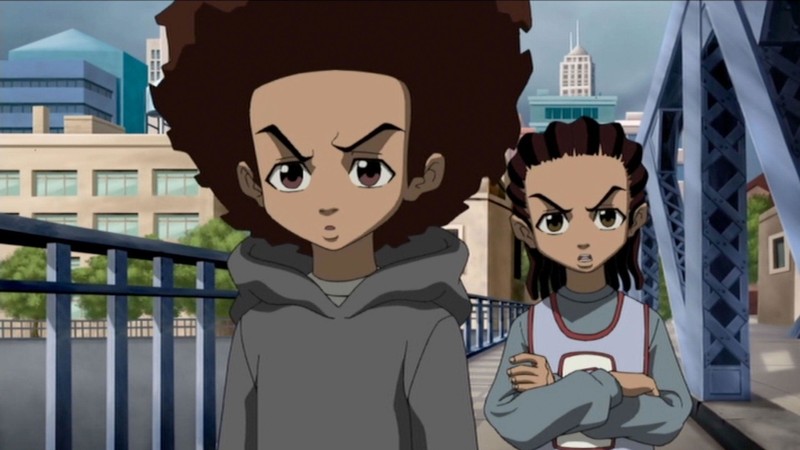
Then there's The Boondocks.
Created by Aaron McGruder, the series was an American production rather than Japanese anime, but it deliberately borrowed heavily from anime's visual language.
Its fight scenes, exaggerated expressions, camera movements, action sequences, and opening imagery demonstrated just how much Japanese animation had entered American Black pop culture.
At the same time, The Boondocks was deeply rooted in African-American culture, politics, music, and social commentary.
Netflix has described the series as another example of the increasingly blurred line between Black music and anime, noting its anime-inspired artwork and hip-hop-driven storytelling.
That's an important turning point.
The influence wasn't traveling in only one direction anymore.
Japanese animation influenced Black American animation.
Black American culture influenced the content being produced.
And the two started blending together.
Anime Started Showing Up in Hip-Hop
By the 2000s and 2010s, the relationship became impossible to ignore.
Anime references began appearing throughout Black American music and entertainment.
Kanye West's "Stronger" famously incorporated imagery inspired by Akira.
Lupe Fiasco named his album Tetsuo & Youth after Akira's Tetsuo.
Wiz Khalifa and Curren$y's "The Check Point" incorporated footage from Samurai Champloo.
Later artists such as Lil Uzi Vert and Megan Thee Stallion openly incorporated anime references into their music, fashion, and public image.
And this wasn't limited to rappers.
Anime became increasingly visible in:
music videos → fashion → tattoos → sneakers → streetwear → social media → conventions → gaming culture.
Eventually, wearing an anime shirt wasn't necessarily something you had to explain.
It became part of the aesthetic.
Then Black Creators Started Making Their Own Anime
This might be the most important part of the entire story.
Black audiences didn't remain consumers forever.
Black creators began entering the animation industry and creating their own anime-influenced worlds.
One of the most prominent examples is LeSean Thomas.

Thomas has worked on projects including The Boondocks, The Legend of Korra, Cannon Busters, and Yasuke.
And Cannon Busters is particularly interesting because it demonstrates what happens when someone who grew up loving anime gets the opportunity to create their own world using that visual language.
Instead of simply asking:
"Where are the Black characters in anime?"
Black creators could start asking:
"What would anime look like if we created the world?"
That's a much bigger question.
Yasuke Brings Everything Full Circle
And then there's Yasuke.
The historical Yasuke was an African man who arrived in Japan during the 16th century and served under Oda Nobunaga.
Centuries later, LeSean Thomas — a Black American animator from the South Bronx — encountered Yasuke's story and became fascinated by it.
That eventually became the Netflix anime Yasuke, produced by Japanese animation studio MAPPA, with Thomas serving as creator and Flying Lotus providing the music.
The symbolism is almost too perfect.
An African man traveled to Japan centuries ago.
Hundreds of years later, a Black American creator traveled into the Japanese animation industry and helped tell his story.
And now that story could reach millions of people around the world.
Thomas has talked about wanting Black audiences to see themselves represented as heroes in animation and about the importance of creating characters that aren't defined exclusively by racial trauma.
That's a major evolution.
So Who Influenced Who?
Here's where the conversation gets interesting.
It's tempting to ask:
"Did Black culture influence anime?"
The answer is yes.
But that's only half the story.
Anime ALSO influenced Black American culture.
And eventually, the two started influencing each other.
Japan → Black American culture
Japanese anime and manga influenced:
-
Art
-
Fashion
-
Music videos
-
Tattoos
-
Streetwear
-
Internet culture
-
Gaming
-
Animation
-
Cosplay
-
Black nerd/Blerd identity
Black American culture → Japanese anime
Black American culture influenced:
-
Hip-hop-inspired soundtracks
-
Jazz and blues aesthetics
-
Funk
-
Street dance
-
Graffiti
-
Fashion
-
Character design
-
Music production
-
Storytelling aesthetics
And then you get creators and projects sitting directly in the middle.
Samurai Champloo
Afro Samurai
The Boondocks
Cannon Busters
Yasuke
These aren't simply "Black anime" or "Japanese anime."
They're examples of cultures colliding, remixing, and creating something new.
The Real Story Is Cultural Cross-Pollination
Maybe the best way to understand this entire relationship is to stop thinking of culture as a one-way pipeline.
Culture doesn't work that way.
A Japanese creator can grow up watching Soul Train, become fascinated by hip-hop, and incorporate those ideas into a samurai anime.
A Black kid in America can watch that anime on Toonami, fall in love with Mugen, and eventually become an animator.
A rapper can grow up watching Dragon Ball Z and later reference Goku in a song.
A Black fashion designer can combine anime imagery with streetwear.
A producer can make an anime soundtrack.
A Japanese animation studio can collaborate with a Black American creator.
And suddenly, something that started in one culture has traveled across the world, been transformed, and returned in a completely different form.
That's not simply influence.
That's cultural exchange.
And That's Why Anime Fits So Naturally Into Blerd Culture
This is one reason the relationship between anime and Black culture feels so natural today.
Anime gives Black audiences another mythology to play with.
The heroes don't have to look like us for their stories to resonate with us.
We can connect with Goku's determination.
Vegeta's pride.
Naruto's isolation.
Luffy's freedom.
Ichigo's responsibility.
Mugen's rebelliousness.
And then we take those characters, those stories, those aesthetics, and make them part of our own cultural expression.
We remix them.
Just like hip-hop remixes samples.
Just like anime creators remix genres.
Just like fashion remixes decades of styles.
That's what culture does.
It takes something you love and asks:
"What can I make with this?"
And maybe that's the most interesting part of the relationship between Black American culture and anime.
Neither side stayed the same.
They changed each other.
The Bottom Line
The history between Black American culture and anime isn't simply a story of Japanese creators borrowing from Black culture.
And it isn't simply a story of Black Americans adopting Japanese entertainment.
It's both.
Jazz influenced anime.
Hip-hop influenced anime.
Anime influenced Black animation.
Anime influenced hip-hop artists.
Asian martial arts influenced hip-hop.
Black creators entered the anime industry.
And audiences on both sides continued remixing everything they encountered.
From Cowboy Bebop to Samurai Champloo, from Wu-Tang to Afro Samurai, from The Boondocks to Yasuke, the relationship keeps evolving.
And honestly?
We're probably still in the early chapters.
The next generation of Black animators, musicians, artists, designers, and Blerds aren't just consuming anime.
They're creating the next remix.